Given below is a diagram of a human blood smear
Human Physiology (10)Given below is a diagram of a human blood smear.
Study the diagram and answer the questions that follow:
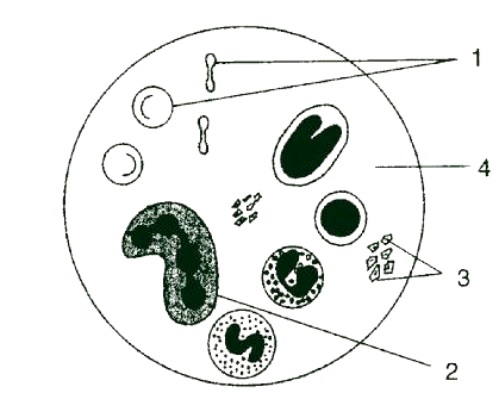
- Name the components numbered ‘1’ to ‘4’.
- Mention two structural differences between the parts ‘1’ and ‘2’.
- Name the soluble protein found in part ‘4’ which forms insoluble threads during clotting of blood.
- What is the average lifespan of the component numbered ‘1’?
- Component numbered ‘1’ do not have certain organelles but are very efficient in their function. Explain.
Answer
- RBCs / Erythrocytes
- WBC / Leucocytes/named WBC
- Platelets / Thrombocytes
- Plasma
1. RBC
- Biconcave disc like
- Nucleus absent
- Haemoglobin present
2. WBC
- Irregular, amoeboid
- Nucleus present
- Haemoglobin absent
(iii) Fibrinogen
(iv) 120 days
(v) Absence of nucleus increases the surface area for absorbing more oxygen / more RBCs can be accommodated.
Absence of mitochondria means they do not use oxygen for respiration, hence all the transported to tissues.
Absence of endoplasmic reticulum increases the flexibility to move through narrow capillaries.
- Exam Year: 2018